The Nazi Party and Their Attack on the Modern Art World

Degenerate art (German: Entartete Kunst ) was a term adopted in the 1920s by the Nazi Political party in Germany to draw modern fine art. During the dictatorship of Adolf Hitler, German modernist art, including many works of internationally renowned artists, was removed from state-owned museums and banned in Nazi Germany on the grounds that such art was an "insult to German feeling", united nations-German, Freemasonic, Jewish, or Communist in nature. Those identified every bit degenerate artists were subjected to sanctions that included being dismissed from teaching positions, existence forbidden to exhibit or to sell their art, and in some cases being forbidden to produce art.[1]
Degenerate Art also was the championship of an exhibition, held by the Nazis in Munich in 1937, consisting of 650 modernist artworks chaotically hung and accompanied by text labels deriding the art. Designed to inflame public opinion confronting modernism, the exhibition subsequently traveled to several other cities in Germany and Austria.
While modern styles of art were prohibited, the Nazis promoted paintings and sculptures that were traditional in style and that exalted the "blood and soil" values of racial purity, militarism, and obedience. Similar restrictions were placed upon music, which was expected to exist tonal and free of whatever jazz influences; disapproved music was termed degenerate music. Films and plays were besides censored.[2]
Theories of degeneracy [edit]
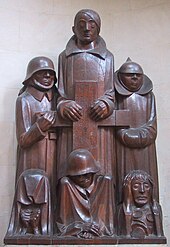
Das Magdeburger Ehrenmal (the Magdeburg cairn), by Ernst Barlach was alleged to be degenerate art due to the "deformity" and emaciation of the figures—respective to Nordau'due south theorized connection betwixt "mental and concrete degeneration".
The term Entartung (or "degeneracy") had gained currency in Frg by the belatedly 19th century when the critic and author Max Nordau devised the theory presented in his 1892 volume Entartung.[three] Nordau drew upon the writings of the criminologist Cesare Lombroso, whose The Criminal Man, published in 1876, attempted to show that at that place were "born criminals" whose atavistic personality traits could be detected by scientifically measuring abnormal physical characteristics. Nordau developed from this premise a critique of modern fine art, explained every bit the piece of work of those and so corrupted and enfeebled past modern life that they have lost the self-control needed to produce coherent works. He attacked Aestheticism in English language literature and described the mysticism of the Symbolist motion in French literature as a product of mental pathology. Explaining the painterliness of Impressionism as the sign of a diseased visual cortex, he decried modernistic degeneracy while praising traditional German culture. Despite the fact that Nordau was Jewish and a central figure in the Zionist movement (Lombroso was besides Jewish), his theory of artistic degeneracy would be seized upon past German Nazis during the Weimar Commonwealth as a rallying point for their antisemitic and racist demand for Aryan purity in art.
Belief in a Germanic spirit—defined every bit mystical, rural, moral, bearing aboriginal wisdom, and noble in the confront of a tragic destiny—existed long before the rising of the Nazis; the composer Richard Wagner celebrated such ideas in his writings.[4] [5] Beginning before World War I, the well-known German architect and painter Paul Schultze-Naumburg's influential writings, which invoked racial theories in condemning modern art and architecture, supplied much of the basis for Adolf Hitler'south conventionalities that classical Hellenic republic and the Eye Ages were the true sources of Aryan art.[six] Schultze-Naumburg subsequently wrote such books as Die Kunst der Deutschen. Ihr Wesen und ihre Werke (The art of the Germans. Its nature and its works) and Kunst und Rasse (Fine art and Race), the latter published in 1928, in which he argued that just racially pure artists could produce a healthy art which upheld timeless ideals of classical beauty, while racially mixed modern artists produced matted artworks and monstrous depictions of the human form. By reproducing examples of modern art next to photographs of people with deformities and diseases, he graphically reinforced the idea of modernism every bit a sickness.[7] Alfred Rosenberg developed this theory in Der Mythos des 20. Jahrhunderts (Myth of the Twentieth Century), published in 1933, which became a all-time-seller in Deutschland and made Rosenberg the Political party's leading ideological spokesman.[viii]
Reactions against modernism in Imperial and Weimar Germany [edit]

The early 20th century was a period of wrenching changes in the arts. In the visual arts, such innovations equally Fauvism, Cubism, Dada, and Surrealism—post-obit Symbolism and Mail-Impressionism—were not universally appreciated. The majority of people in Deutschland, every bit elsewhere, did not care for the new art, which many resented as elitist, morally suspect, and too often incomprehensible.[9] Wilhelm Ii, who took an active interest in regulating art in Frg, criticized Impressionism every bit "gutter painting" ( Gossenmalerei )[10] and forbade Käthe Kollwitz from beingness awarded a medal for her impress serial A Weavers' Revolt when it was displayed in the Berlin K Exhibition of the Arts in 1898.[11] In 1913, the Prussian business firm of representatives passed a resolution "against degeneracy in art".[ten]
Under the Weimar government of the 1920s, Germany emerged as a leading center of the advanced. It was the birthplace of Expressionism in painting and sculpture, of the atonal musical compositions of Arnold Schoenberg, and the jazz-influenced piece of work of Paul Hindemith and Kurt Weill. Films such every bit Robert Wiene'due south The Chiffonier of Dr. Caligari (1920) and F. W. Murnau'south Nosferatu (1922) brought Expressionism to movie theater.
The Nazis viewed the culture of the Weimar period with cloy. Their response stemmed partly from a bourgeois artful gustation and partly from their determination to use culture equally a propaganda tool.[12] On both counts, a painting such equally Otto Dix'south State of war Cripples (1920) was anathema to them. Information technology unsparingly depicts four badly disfigured veterans of the Commencement World State of war, then a familiar sight on Berlin's streets, rendered in caricatured style. (In 1937, it would exist displayed in the Degenerate Art exhibition adjacent to a label accusing Dix—himself a volunteer in World War I[13]—of "an insult to the German heroes of the Great War".[14])
Art historian Henry Grosshans says that Hitler "saw Greek and Roman art as uncontaminated by Jewish influences. Modernistic art was [seen every bit] an act of aesthetic violence by the Jews confronting the High german spirit. Such was truthful to Hitler even though only Liebermann, Meidner, Freundlich, and Marc Chagall, amongst those who made significant contributions to the German modernist motion, were Jewish. Only Hitler ... took upon himself the responsibility of deciding who, in matters of culture, idea and acted like a Jew."[15] The supposedly "Jewish" nature of all art that was indecipherable, distorted, or that represented "depraved" subject thing was explained through the concept of degeneracy, which held that distorted and corrupted art was a symptom of an inferior race. By propagating the theory of degeneracy, the Nazis combined their antisemitism with their bulldoze to command the culture, thus consolidating public support for both campaigns.[16]
Nazi purge [edit]
In 1930 Wilhelm Frick, a Nazi, became Minister for Culture and Education in the state of Thuringia.[17] Past his guild, 70 by and large Expressionist paintings were removed from the permanent exhibition of the Weimar Schlossmuseum in 1930, and the manager of the König Albert Museum in Zwickau, Hildebrand Gurlitt, was dismissed for displaying modern art.[10]

Albert Gleizes, 1912, Landschaft bei Paris, Paysage près de Paris, Paysage de Courbevoie, missing from Hannover since 1937[one] [18]

Hitler'due south ascent to power on January 31, 1933, was quickly followed by actions intended to cleanse the culture of degeneracy: book burnings were organized, artists and musicians were dismissed from teaching positions, and curators who had shown a partiality for modern art were replaced by Political party members.[21] In September 1933, the Reichskulturkammer (Reich Culture Bedroom) was established, with Joseph Goebbels, Hitler's Reichsminister für Volksaufklärung und Propaganda (Reich Government minister for Public Enlightenment and Propaganda) in charge. Sub-chambers within the Civilisation Chamber, representing the private arts (music, film, literature, architecture, and the visual arts) were created; these were membership groups consisting of "racially pure" artists supportive of the Party, or willing to be compliant. Goebbels made it clear: "In future just those who are members of a sleeping accommodation are allowed to be productive in our cultural life. Membership is open just to those who fulfill the entrance condition. In this way all unwanted and dissentious elements have been excluded."[22] Past 1935 the Reich Culture Chamber had 100,000 members.[22]
As dictator, Hitler gave his personal taste in art the force of law to a caste never before seen. Only in Stalin'southward Soviet Union, where Socialist Realism was the mandatory way, had a modernistic state shown such concern with regulation of the arts.[23] In the example of Frg, the model was to be classical Greek and Roman art, regarded past Hitler equally an art whose outside course embodied an inner racial ideal.[24]
Nonetheless, during 1933–1934 there was some confusion within the Political party on the question of Expressionism. Goebbels and some others believed that the forceful works of such artists as Emil Nolde, Ernst Barlach and Erich Heckel exemplified the Nordic spirit; as Goebbels explained, "We National Socialists are not unmodern; we are the carrier of a new modernity, non only in politics and in social matters, but as well in art and intellectual matters."[25] However, a faction led by Alfred Rosenberg despised the Expressionists, and the result was a biting ideological dispute, which was settled only in September 1934, when Hitler alleged that there would be no place for modernist experimentation in the Reich.[26] This edict left many artists initially uncertain every bit to their condition. The work of the Expressionist painter Emil Nolde, a committed fellow member of the Nazi party, connected to be debated even later on he was ordered to finish artistic activity in 1936.[27] For many modernist artists, such every bit Max Beckmann, Ernst Ludwig Kirchner, and Oskar Schlemmer, it was non until June 1937 that they surrendered any hope that their piece of work would exist tolerated by the authorities.[28]
Although books by Franz Kafka could no longer be bought by 1939, works by ideologically doubtable authors such as Hermann Hesse and Hans Fallada were widely read.[29] Mass culture was less stringently regulated than high civilisation, possibly considering the authorities feared the consequences of too heavy-handed interference in popular entertainment.[30] Thus, until the outbreak of the war, most Hollywood films could exist screened, including It Happened One Night, San Francisco, and Gone with the Current of air. While performance of atonal music was banned, the prohibition of jazz was less strictly enforced. Benny Goodman and Django Reinhardt were pop, and leading British and American jazz bands continued to perform in major cities until the war; thereafter, dance bands officially played "swing" rather than the banned jazz.[31]
Entartete Kunst showroom [edit]
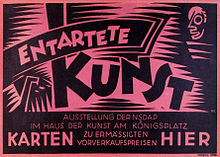
Entartete Kunst poster, Berlin, 1938

Letter to Emil Nolde in 1941 from Adolf Ziegler, who declares that Nolde's art is degenerate art, and forbids him to paint.
By 1937, the concept of degeneracy was firmly entrenched in Nazi policy. On June xxx of that twelvemonth Goebbels put Adolf Ziegler, the caput of Reichskammer der Bildenden Künste (Reich Bedroom of Visual Fine art), in charge of a six-man commission authorized to confiscate from museums and art collections throughout the Reich, any remaining art accounted modern, degenerate, or subversive. These works were then to be presented to the public in an exhibit intended to incite further revulsion against the "perverse Jewish spirit" penetrating High german civilisation.[32]
Over 5000 works were seized, including 1052 by Nolde, 759 by Heckel, 639 past Ernst Ludwig Kirchner and 508 by Max Beckmann, also equally smaller numbers of works past such artists every bit Alexander Archipenko, Marc Chagall, James Ensor, Albert Gleizes, Henri Matisse, Jean Metzinger, Pablo Picasso, and Vincent van Gogh.[33] The Entartete Kunst exhibit, featuring over 650 paintings, sculptures, prints, and books from the collections of 32 German museums, premiered in Munich on July nineteen, 1937, and remained on view until November 30, before traveling to 11 other cities in Germany and Republic of austria.
The exhibit was held on the second floor of a building formerly occupied by the Constitute of Archaeology. Viewers had to reach the exhibit past means of a narrow staircase. The start sculpture was an oversized, theatrical portrait of Jesus, which purposely intimidated viewers as they literally bumped into it in order to enter. The rooms were made of temporary partitions and deliberately chaotic and overfilled. Pictures were crowded together, sometimes unframed, usually hung past cord.
The first 3 rooms were grouped thematically. The kickoff room contained works considered demeaning of religion; the second featured works past Jewish artists in particular; the 3rd independent works deemed insulting to the women, soldiers and farmers of Federal republic of germany. The rest of the showroom had no particular theme.
At that place were slogans painted on the walls. For example:
- Insolent mockery of the Divine under Centrist dominion
- Revelation of the Jewish racial soul
- An insult to High german womanhood
- The platonic—cretin and whore
- Deliberate demolition of national defense
- German farmers—a Yiddish view
- The Jewish longing for the wilderness reveals itself—in Germany the Negro becomes the racial ideal of a degenerate art
- Madness becomes method
- Nature every bit seen by sick minds
- Even museum bigwigs called this the "art of the German language people"[34]
Speeches of Nazi political party leaders assorted with creative person manifestos from various art movements, such equally Dada and Surrealism. Side by side to many paintings were labels indicating how much coin a museum spent to acquire the artwork. In the instance of paintings acquired during the post-state of war Weimar hyperinflation of the early on 1920s, when the cost of a kilogram loaf of bread reached 233 billion German marks,[35] the prices of the paintings were of course greatly exaggerated. The showroom was designed to promote the thought that modernism was a conspiracy by people who hated German decency, ofttimes identified as Jewish-Bolshevist, although only 6 of the 112 artists included in the exhibition were in fact Jewish.[36]
The exhibition programme contained photographs of modernistic artworks accompanied by defamatory text.[37] The cover featured the exhibition championship—with the discussion "Kunst" , pregnant art, in scare quotes—superimposed on an image of Otto Freundlich's sculpture Der Neue Mensch .
A few weeks afterward the opening of the exhibition, Goebbels ordered a second and more than thorough scouring of German art collections; inventory lists indicate that the artworks seized in this second round, combined with those gathered prior to the exhibition, amounted to xvi,558 works.[38] [39]
Coinciding with the Entartete Kunst exhibition, the Große Deutsche Kunstausstellung (Cracking High german art exhibition) made its premiere among much pageantry. This exhibition, held at the deluxe Haus der deutschen Kunst (House of High german Art), displayed the piece of work of officially approved artists such as Arno Breker and Adolf Wissel. At the end of four months Entartete Kunst had attracted over two million visitors, about three and a half times the number that visited the nearby Große Deutsche Kunstausstellung.[40]
Fate of the artists and their work [edit]
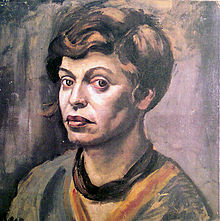
Avant-garde High german artists were now branded both enemies of the state and a threat to German culture. Many went into exile. Max Beckmann fled to Amsterdam on the opening day of the Entartete Kunst exhibit.[41] Max Ernst emigrated to America with the aid of Peggy Guggenheim. Ernst Ludwig Kirchner committed suicide in Switzerland in 1938. Paul Klee spent his years in exile in Switzerland, nevertheless was unable to obtain Swiss citizenship because of his status equally a degenerate artist. A leading German dealer, Alfred Flechtheim, died penniless in exile in London in 1937.
Other artists remained in internal exile. Otto Dix retreated to the countryside to pigment unpeopled landscapes in a meticulous way that would non provoke the authorities.[42] The Reichskulturkammer forbade artists such as Edgar Ende and Emil Nolde from purchasing painting materials. Those who remained in Federal republic of germany were forbidden to work at universities and were subject to surprise raids by the Gestapo in society to ensure that they were not violating the ban on producing artwork; Nolde secretly carried on painting, only using only watercolors (so as not to be betrayed past the telltale odor of oil paint).[43] Although officially no artists were put to death considering of their work, those of Jewish descent who did non escape from Germany in fourth dimension were sent to concentration camps.[44] Others were murdered in the Action T4 (see, for example, Elfriede Lohse-Wächtler).
After the exhibit, paintings were sorted out for sale and sold in Switzerland at sale; some pieces were caused by museums, others past private collectors. Nazi officials took many for their private utilize: for case, Hermann Göring took 14 valuable pieces, including a Van Gogh and a Cézanne. In March 1939, the Berlin Fire Brigade burned nearly 4000 paintings, drawings and prints that had obviously trivial value on the international market. This was an act of unprecedented vandalism, although the Nazis were well used to book burnings on a big calibration.[45] [46]
A large amount of "degenerate art" past Picasso, Dalí, Ernst, Klee, Léger and Miró was destroyed in a bonfire on the night of July 27, 1942, in the gardens of the Galerie nationale du Jeu de Paume in Paris.[47] Whereas it was forbidden to consign "degenerate art" to Frg, it was however possible to buy and sell artworks of "degenerate artists" in occupied France. The Nazis considered indeed that they should non exist concerned by Frenchmen'south mental health.[48] Equally a consequence, many works made past these artists were sold at the main French auction house during the occupation.[49]
The couple Sophie and Emanuel Fohn, who exchanged the works for harmless works of fine art from their own possession and kept them in safe custody throughout the National Socialist era, saved about 250 works by ostracized artists. The collection survived in South Tyrol from 1943 and was handed over to the Bavarian State Painting Collections in 1964.[fifty]
After the collapse of Nazi Deutschland and the invasion of Berlin by the Ruby-red Ground forces, some artwork from the exhibit was found buried underground. It is unclear how many of these and then reappeared in the Hermitage Museum in St. petersburg, where they still remain.
In 2010, every bit piece of work began to extend an underground line from Alexanderplatz through the historic city centre to the Brandenburg Gate, a number of sculptures from the degenerate fine art exhibition were unearthed in the cellar of a individual house shut to the "Rote Rathaus". These included, for instance, the bronze cubist-style statue of a female person dancer by the artist Marg Moll, and are at present on display at the Neues Museum.[51] [52] [53]
Artists in the 1937 Munich show [edit]
- Jankel Adler
- Hans Baluschek
- Ernst Barlach
- Rudolf Bauer
- Philipp Bauknecht
- Otto Baum
- Willi Baumeister
- Herbert Bayer
- Max Beckmann
- Rudolf Belling
- Paul Bindel
- Theodor Brün
- Max Burchartz
- Fritz Burger-Mühlfeld
- Paul Camenisch
- Heinrich Campendonk
- Karl Caspar
- Maria Caspar-Filser
- Pol Cassel
- Marc Chagall
- Lovis Corinth
- Heinrich Maria Davringhausen
- Walter Dexel
- Johannes Diesner
- Otto Dix
- Pranas Domšaitis
- Hans Christoph Drexel
- Johannes Driesch
- Heinrich Eberhard
- Max Ernst
- Hans Feibusch
- Lyonel Feininger
- Conrad Felixmüller
- Otto Freundlich
- Xaver Fuhr
- Ludwig Gies
- Werner Gilles
- Otto Gleichmann
- Rudolf Großmann
- George Grosz
- Hans Grundig
- Rudolf Haizmann
- Raoul Hausmann
- Guido Hebert
- Erich Heckel
- Wilhelm Heckrott
- Jacoba van Heemskerck
- Hans Siebert von Heister
- Oswald Herzog
- Werner Heuser
- Heinrich Hoerle
- Karl Hofer
- Eugen Hoffmann
- Johannes Itten
- Alexej von Jawlensky
- Eric Johansson
- Hans Jürgen Kallmann
- Wassily Kandinsky
- Hanns Katz
- Ernst Ludwig Kirchner
- Paul Klee
- Cesar Klein
- Paul Kleinschmidt
- Oskar Kokoschka
- Otto Lange
- Wilhelm Lehmbruck
- Elfriede Lohse-Wächtler
- El Lissitzky
- Oskar Lüthy
- Franz Marc
- Gerhard Marcks
- Ewald Mataré
- Ludwig Meidner
- Jean Metzinger
- Constantin von Mitschke-Collande
- László Moholy-Nagy
- Marg Moll
- Oskar Moll
- Johannes Molzahn
- Piet Mondrian
- Georg Muche
- Otto Mueller
- Magda Nachman Acharya
- Erich Nagel
- Heinrich Nauen
- Ernst Wilhelm Nay
- Karel Niestrath
- Emil Nolde
- Otto Pankok
- Max Pechstein
- Max Peiffer Watenphul
- Hans Purrmann
- Max Rauh
- Hans Richter
- Emy Roeder
- Christian Rohlfs
- Edwin Scharff
- Oskar Schlemmer
- Rudolf Schlichter
- Karl Schmidt-Rottluff
- Werner Scholz
- Lothar Schreyer
- Otto Schubert
- Kurt Schwitters
- Lasar Segall
- Fritz Skade
- Heinrich Stegemann
- Fritz Stuckenberg
- Paul Thalheimer
- Johannes Tietz
- Arnold Topp
- Friedrich Vordemberge-Gildewart
- Karl Völker
- Christoph Voll
- William Wauer
- Gert Heinrich Wollheim
Artistic movements condemned as degenerate [edit]
- Bauhaus
- Cubism
- Dada
- Expressionism
- Fauvism
- Impressionism
- Postal service-Impressionism
- New Objectivity
- Surrealism
Listing [edit]
The Reichsministerium für Volksaufklärung und Propaganda (Reich Ministry of Public Enlightenment and Propaganda) compiled a 479-folio, ii-volume typewritten listing of the works confiscated as "degenerate" from Germany's public institutions in 1937–38. In 1996 the Victoria and Albert Museum in London acquired the only known surviving copy of the complete list. The document was donated to the 5&A's National Art Library by Elfriede Fischer, the widow of the art dealer Heinrich Robert ("Harry") Fischer. Copies were fabricated available to other libraries and research organisations at the time, and much of the data was subsequently incorporated into a database maintained by the Freie Universität Berlin.[54] [55]
A digital reproduction of the unabridged inventory was published on the Victoria and Albert Museum's website in January 2014. The 5&A's publication consists of two PDFs, one for each of the original volumes. Both PDFs also include an introduction in English and High german.[56] An online version of the inventory was fabricated available on the Five&A's website in November 2019, with additional features. The new edition uses IIIF page-turning software and incorporates an interactive index arranged by urban center and museum. The earlier PDF edition remains available too.[57]
The V&A's copy of the full inventory is thought to have been compiled in 1941 or 1942, after the sales and disposals were completed.[58] Two copies of an earlier version of Volume 1 (A–K) also survive in the German Federal Archives in Berlin, and one of these is annotated to show the fate of individual artworks. Until the V&A obtained the complete inventory in 1996, all versions of Volume 2 (G–Z) were idea to take been destroyed.[59] The listings are arranged alphabetically by metropolis, museum and artist. Details include artist surname, inventory number, title and medium, followed by a code indicating the fate of the artwork, and so the surname of the buyer or fine art dealer (if whatever) and whatsoever price paid.[59] The entries also include abbreviations to indicate whether the piece of work was included in whatever of the various Entartete Kunst exhibitions (see Degenerate Art Exhibition) or Der ewige Jude (run into The Eternal Jew (art exhibition)).[60]
The principal dealers mentioned are Bernhard A. Böhmer (or Boehmer), Karl Buchholz, Hildebrand Gurlitt, and Ferdinand Möller. The manuscript also contains entries for many artworks acquired by the artist Emanuel Fohn, in substitution for other works.[61]
21st-century reactions [edit]
Neil Levi, writing in The Chronicle of Higher Education, suggested that the branding of art as "degenerate" was just partly an artful aim of the Nazis. Another was the confiscation of valuable artwork, a deliberate means to enrich the government.[62]
In popular culture [edit]
A Picasso, a play by Jeffrey Hatcher based loosely on actual events, is set in Paris 1941 and sees Picasso beingness asked to authenticate three works for inclusion in an upcoming exhibition of Degenerate art.[63] [64]
In the 1964 film The Train, a German Army colonel attempts to steal hundreds of "degenerate" paintings from Paris earlier it is liberated during World War Ii.[65]
See besides [edit]
- Gurlitt Collection
- Karl Buchholz (art dealer)
- Art of the Third Reich
- Low culture
- Nazi plunder
References [edit]
Notes [edit]
- ^ a b "Entartete Kunst (Degenerate Art), complete inventory of over xvi,000 artworks confiscated by the Nazi government from public institutions in Frg, 1937–1938, Reichsministerium für Volksaufklärung und Propaganda. Victoria and Albert Museum, Albert Gleizes, Landschaft bei Paris, n. 7030, Volume 2, p. 57 (includes the Entartete Kunst inventory)". Vam.ac.uk. 1939-06-xxx. Retrieved 2014-08-14 .
- ^ "The Collection | Entartete Kunst". MoMA. Retrieved 2010-08-12 .
- ^ Barron 1991, p. 26.
- ^ Adam 1992, pp. 23–24.
- ^ Newman, Ernest, and Richard Wagner (1899). A Study of Wagner. London: Dobell. pp. 272–275. OCLC 253374235.
- ^ Adam 1992, pp. 29–32.
- ^ Grosshans 1983, p. 9. Grosshans calls Schultze-Naumburg "[u]ndoubtedly the nearly important" of the era's German critics of modernism.
- ^ Adam 1992, p. 33.
- ^ Adam 1992, p. 29.
- ^ a b c Kühnel, Anita (2003). "Entartete Kunst". Grove Art Online.
- ^ Goldstein, Robert Justin, and Andrew Nedd (2015). Political Censorship of the Visual Arts in Nineteenth-Century Europe: Arresting Images. Basingstoke, Hampshire: Palgrave Macmillan. p. 159. ISBN 9780230248700.
- ^ Adam 1992, p. 110.
- ^ Norbert Wolf, Uta Grosenick (2004), Expressionism, Taschen, p. 34. ISBN 3-8228-2126-viii.
- ^ Barron 1991, p. 54.
- ^ Grosshans 1983, p. 86.
- ^ Barron 1991, p. 83.
- ^ Zalampas, Sherree Owens, 1937- (1990). Adolf Hitler : a psychological interpretation of his views on architecture, art, and music. Bowling Greenish, Ohio: Bowling Green University Pop Printing. ISBN0879724870. OCLC 22438356.
{{cite book}}: CS1 maint: multiple names: authors list (link), p. 54 - ^ Albert Gleizes, Paysage près de Paris (Paysage de Courbevoie, Landschaft bei Paris), oil on canvas, 72.eight × 87.1 cm. Lost Fine art Internet Database, Stiftung Deutsches Zentrum Kulturgutverluste.
- ^ "Jean Metzinger, Im Boot (En Canot), Degenerate Art Database (Beschlagnahme Inventar, Entartete Kunst)". Emuseum.campus.fu-berlin.de. Retrieved 2013-11-09 .
- ^ "Degenerate Art Database (Beschlagnahme Inventar, Entartete Kunst)". Emuseum.campus.fu-berlin.de. Retrieved 2013-11-09 .
- ^ Adam 1992, p. 52.
- ^ a b Adam 1992, p. 53.
- ^ Barron 1991, p. 10.
- ^ Grosshans 1983, p. 87.
- ^ Adam 1992, p. 56.
- ^ Grosshans 1983, pp. 73–74.
- ^ Boa, Elizabeth, and Rachel Palfreyman (2000). Heimat: a German Dream: Regional Loyalties and National Identity in German Civilisation, 1890–1990. Oxford: Oxford Academy Printing. p. 158. ISBN 0198159226.
- ^ Kimmelman, Michael (June 19, 2014). "The Art Hitler Hated". The New York Review of Books 61 (11): 25–26.
- ^ Laqueur 1996, p. 74.
- ^ Laqueur 1996, p. 73.
- ^ Laqueur 1996, pp. 73–75.
- ^ Adam 1992, p. 123, quoting Goebbels, November 26, 1937, in Von der Grossmacht zur Weltmacht.
- ^ Adam 1992, pp. 121–122.
- ^ Barron 1991, p. 46.
- ^ Evans 2004, p. 106.
- ^ Barron 1991, p. 9.
- ^ Barron, Stephanie, Guenther and Peter W., "Degenerate Art": The Fate of the Advanced in Nazi Deutschland], LACMA, 1991, ISBN 0810936534.
- ^ Barron 1991, pp. 47–48.
- ^ "Entartete Kunst (Degenerate Art), complete inventory of artworks confiscated by the Nazi regime from public institutions in Deutschland, 1937–1938, Reichsministerium für Volksaufklärung und Propaganda. Victoria and Albert Museum". Vam.ac.uk. 1939-06-30. Retrieved 2014-08-xiv .
- ^ Adam 1992, pp. 124–125.
- ^ Schulz-Hoffmann and Weiss 1984, p. 461.
- ^ Karcher 1988, p. 206.
- ^ Bradley 1986, p. 115.
- ^ Petropoulos 2000, p. 217.
- ^ Grosshans 1983, p. 113.
- ^ "Entartete Kunst". Olinda.com. 1937-07-19. Retrieved 2010-08-12 .
- ^ Hellman, Mallory, Allow'due south Go Paris, p. 84.
- ^ Bertrand Dorléac, Laurence (1993). L'art de la défaite, 1940–1944. Paris: Editions du Seuil. p. 482. ISBN 2020121255.
- ^ Oosterlinck, Kim (2009). "The Toll of Degenerate Art", Working Papers CEB 09-031.RS, ULB – Universite Libre de Bruxelles.
- ^ Kraus & Obermair 2019, pp. 40–1.
- ^ Hickley, Catherine (1946-09-27). "'Degenerate' Fine art Unearthed From Berlin Flop Rubble". Bloomberg. Retrieved 2010-xi-10 .
- ^ Black, Rosemary (November nine, 2010). "Rescued pre-WWII 'degenerate fine art' on brandish in the Neues Museum in Berlin". Nydailynews.com. Retrieved 2010-xi-ten .
- ^ Charles Hawley (November viii, 2010). "Nazi Degenerate Fine art Rediscovered in Berlin". Der Spiegel.
- ^ "V&A Entartete Kunst webpage". Vam.ac.united kingdom. 1939-06-30. Retrieved 2014-08-14 .
- ^ "Freie Universität Berlin Database "Entartete Kunst"". Geschkult.fu-berlin.de. 2013-08-28. Retrieved 2014-08-14 .
- ^ Entartete Kunst, Victoria and Albert Museum. 2014.
- ^ Explore 'Entartete Kunst': The Nazis' inventory of 'degenerate art', Victoria and Albert Museum. 2019.
- ^ Victoria and Albert Museum 2014. Introduction by Douglas Dodds & Heike Zech, p. i.
- ^ a b Victoria and Albert Museum 2014. Introduction by Douglas Dodds & Heike Zech, p. ii.
- ^ Victoria and Albert Museum 2014, vol. one, p. vii.
- ^ Victoria and Albert Museum 2014, vol. 1 and 2.
- ^ Neil Levi, "The Uses of Nazi 'Degenerate Fine art'", The Chronicle of Higher Education (Nov. 12, 2013).
- ^ Isherwood, C. (April xx, 2005). "Portrait of the Artist as a Master of the Ane-Liner". The New York Times . Retrieved June 22, 2013.
- ^ Blake, J. (October 3, 2012). "Ve haff vays of being unintentionally funny". Sydney Morning Herald . Retrieved June 22, 2013.
- ^ "Train, The (1965) – (Motion picture Clip) Degenerate Art". Archived from the original on Feb xv, 2015. Retrieved February 15, 2015.
Bibliography [edit]
- Adam, Peter (1992). Art of the 3rd Reich. New York: Harry N. Abrams, Inc. ISBN 0-8109-1912-five
- Barron, Stephanie, ed. (1991). 'Degenerate Art': The Fate of the Avant-Garde in Nazi Germany. New York: Harry Due north. Abrams, Inc. ISBN 0-8109-3653-4
- Bradley, Due west. South. (1986). Emil Nolde and German Expressionism: A prophet in his Own Land. Ann Arbor, Mich: UMI Research Press. ISBN 0-8357-1700-3
- Evans, R. J. (2004). The Coming of the Third Reich. New York: The Penguin Press. ISBN 1-59420-004-1
- Grosshans, Henry (1983). Hitler and the Artists. New York: Holmes & Meyer. ISBN 0-8419-0746-3
- Grosshans, Henry (1993). Hitler and the Artists. New York: Holmes & Meyer. ISBN 0-8109-3653-4
- Karcher, Eva (1988). Otto Dix 1891–1969: His Life and Works. Cologne: Benedikt Taschen. OCLC 21265198
- Kraus, Carl; Obermair, Hannes (2019). Mythen der Diktaturen. Kunst in Faschismus und Nationalsozialismus – Miti delle dittature. Arte nel fascismo e nazionalsocialismo. Landesmuseum für Kultur- und Landesgeschichte Schloss Tirol. ISBN978-88-95523-16-three.
- Laqueur, Walter (1996). Fascism: Past, Present, Future. New York: Oxford University Press. ISBN 0-19-509245-seven
- Lehmann-Haupt, Hellmut (1973). Fine art Under a Dictatorship. New York: Oxford Academy Press.
- Minnion, John (2nd edition 2005). Hitler's List: An Illustrated Guide to 'Degenerates' . Liverpool: Checkmate Books. ISBN 0-9544499-ii-4
- Nordau, Max (1998). Degeneration, introduction past George 50. Mosse. New York: Howard Fertig. ISBN 0-8032-8367-9 / (1895) London: William Heinemann
- O'Brien, Jeff (2015). "'The Taste of Sand in the Mouth': 1939 and 'Degenerate' Egyptian Art". Critical Interventions 9, Issue i: 22–34.
- Oosterlinck, Kim (2009). "The Cost of Degenerate Art", Working Papers CEB 09-031.RS, ULB—Universite Libre de Bruxelles,
- Petropoulos, Jonathan (2000). The Faustian Deal: the Art World in Nazi Germany. New York, North.Y.: Oxford University Press. ISBN 0-nineteen-512964-4
- Rose, Carol Washton Long (1995). Documents from the End of the Wilhemine Empire to the Rise of National Socialism. San Francisco: Academy of California Press. ISBN 0-520-20264-3
- Schulz-Hoffmann, Carla; Weiss, Judith C. (1984). Max Beckmann: Retrospective. Munich: Prestel. ISBN 0-393-01937-3
- Suslav, Vitaly (1994). The State Hermitage: Masterpieces from the Museum's Collections. vol. 2 Western European Art. New York: Harry N. Abrams, Inc. ISBN ane-873968-03-5
- Victoria and Albert Museum (2014). "Entartete" Kunst: digital reproduction of a typescript inventory prepared by the Reichsministerium für Volksaufklärung und Propaganda, ca. 1941/1942. London: Victoria and Albert Museum. (V&A NAL MSL/1996/7)]
External links [edit]
| External video | |
|---|---|
 Art in Nazi Germany, Smarthistory Art in Nazi Germany, Smarthistory |
- "Degenerate Fine art", article from A Instructor'due south Guide to the Holocaust
- Nazis Looted Europe's Great Fine art
- Victoria and Albert Museum Entartete Kunst, Volume i and 2 Consummate inventory of artworks confiscated by the Nazi regime from public institutions in Germany, 1937–1938
- Video clip of the Degenerate art show
- Sensational Observe in a Bombed-Out Cellar - slideshow by Der Spiegel
- "Entartete Kunst: Degenerate Art", notes and a supplement to the film
- Video on a enquiry projection about Degenerate Art
- The "Degenerate Art" Exhibit, 1937
- Drove: "All Artists in the Degenerate Art Testify" from the University of Michigan Museum of Fine art
Source: https://en.wikipedia.org/wiki/Degenerate_art
0 Response to "The Nazi Party and Their Attack on the Modern Art World"
Post a Comment